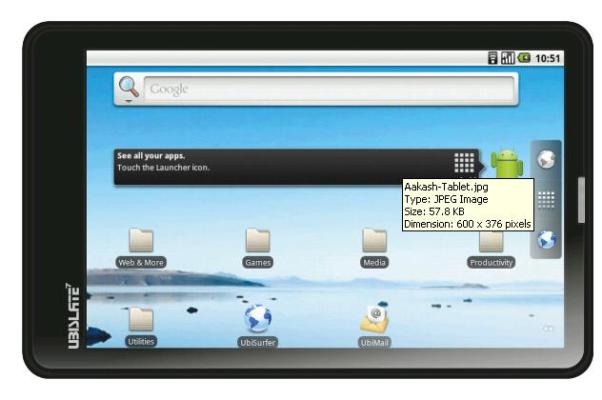
Wednesday, July 16, 2014

275 - Aakash Tablet Maker, Datawind Raises Rs.168 Cr. Via Ipo, Lists


Pooja Sareen on July 15, 2014 at 7:58 am
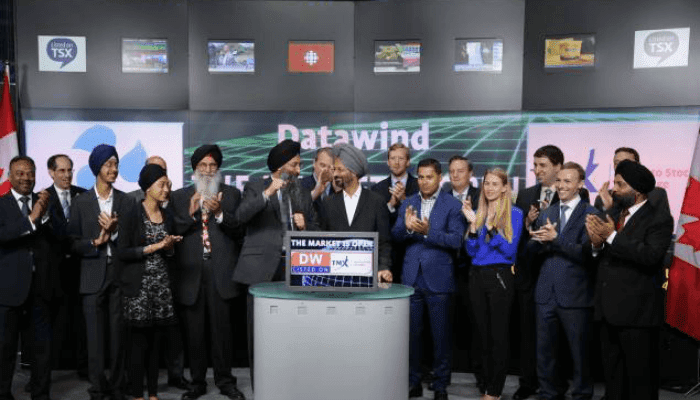


Maker of low cost tablets, Datawind has raised Rs.168 Cr. i.e. C$30 Mn (Canadian Dollar) through an IPO that closed in July 8 and has listed company shares on Toronto Stock Exchange.
“Our IPO (initial public offer) on the TSX (Toronto Stock Exchange) represents a major milestone for Datawind, and gives us the resources to implement the next stage of our vision to bring the internet to billions of unconnected people in the developing world,” said Suneet Singh Tuli, Datawind President and CEO.

Datawind plans to use the raised funds for expanding business across emerging markets. The company now will also be focusing on developing solutions that can facilitate access to internet services at affordable prices.

In its documents filed last month, the company had stated that it plans to sell between 5.2 Mn and 6.3 Mn shares, at a price of between C$4.75 and C$5.75 a share.

Datawind was the first one to make tablet PC Aakash, which cost the government Rs.2,276 per unit. It has also been selected for supplying Aakash 4 (expected to cost around Rs.3,500) and will also support 4G services.

“The world suffers from an internet infrastructure deficit, however, we believe our patented cloud based web delivery technology can effectively leverage existing cellular telephony networks to deliver affordable internet to 93 per cent of the world population,” said Datawind Co-Chairman and CTO Raja Singh Tuli.

Recently, Datawind was recognized by MIT Technology Review in its 2014 list of the world’s 50 smartest companies, as it is acknowledged for its ability to break the affordability barrier with tablet computers for the population at the base of the pyramid, while delivering internet access on existing networks.

DataWind is on the mission to bring internet to billions of unconnected people in the developing world. The Company’s Internet Delivery Platform offers a low-cost Internet browsing solution by bundling an affordable tablet device with an inexpensive, pre-paid, 2G Internet service plan.

Sunday, July 6, 2014

274 - India Seeking For New Makers Of Aakash, The World's Cheapest Tablet


KayRoyster
posted this on Jul 03 08:15

The brand new Speak seven is created to get on the Lenovo A1000, which has equivalent specs in both the hardware and functionalities. The value of the Speak 7 is also a whole lot lower, at RMB499 ($82) it is arguably the cheapest tablet with 3G mobile phone and internet accessibility.

Pressing particular perform keys even though restarting a Dell computer will allow you configure the machine outdoors of Windows. Their functions vary somewhat dependent on what model you use and what model of Windows you are running. If you are not certain what applies to your machine, search for the start off-up choices to flash in the upper correct corner of your Dell's display before it loads Windows. Belkin producers numerous peripherals for computers, including routers and mice. Virtually absolutely everyone with a computer has a mouse. Wireless mice are easy to move close to with no a cumbersome cord attached. But with the lack of a cord comes a handful of frequent issues that cause the mouse not to be detected on wake-up from rest. Even so, most problems can be very easily resolved.

Despite the fact that the RAM is only 512 MB, we uncover it smooth going in searching or basic using of this tablet. Multi tasking or playing large top quality video games may slow down your gadget. It has a Developed in Wifi adapter. But there is no internal sim assistance in this tablet. But you can use external 3G modem, which assistance each 2G and 3G internet connection. This tablet Personal computer has 4 GB inner memory and it supports 32 GB SD Card memory. a 32 GB SD Card may get one thousand BDT in the nearest market of you. So will not be concerned about the internal room. Dual microphone noise reduction, Dolby Digital five.1 Surround Sound, HD video capture and playback, FM Radio and GPS capable. Dual SIM, Dual Standby, Dual Camera, FM Radio and GPS capable VGA front-dealing with camera two.0MP rear-facing camera

Taking YouTube videos and putting them onto a DVD will call for you to first download people video clips to your personal computer. Take YouTube videos and place them onto a DVD with aid from a technology specialist in this free of charge video clip. You can view all of your blocked YouTube contacts by opening a listing in your deal with book. From this checklist, you can also unblock users to restore their capability to comment on your posts and correspond with you via personal message. Simply because you should initial add a consumer to your handle book in buy to block them, all blocked users are your contacts, and they are listed in the Blocked Users record in the deal with book. it's time to update the list of cheapest dual-core powered Android phones currently marketing in the Philippine marketplace these days.

As tablets become a lot more and far more frequent in schooling – as seen in the United States, in which wealthy schools shift from textbooks to tablets – a less costly choice may let a more substantial population to join in. Suneet Tuli, CEO of Datawind, the maker of Aakash two, stated that, “I get college boards and colleges from the US and Canada often calling us up, asking for products. Inner-city colleges say to us, ‘It’s not just a problem above there – forty% of our little ones really don't have accessibility to PCs and the Internet.’”


Placing a YouTube icon onto a pc desktop is named making a shortcut. Spot a YouTube icon onto a personal computer desktop with Kyros Tablet support from an administrative specialist, as properly as a laptop specialist and hardware specialist, in this totally free video clip. Relevance of Meals & Drink Consumption A lot of of the prospective pupil end users may also see the computers much more as a way to chat with friends than read through the lectures India is offering on the web. 12MP rear camera with Flash and BSI Sensor and 2MP front with BSI Sensor Will StarMobile and Torque program to provide Quad-Core Android Phones for Filipinos? Is it possible that Lenovo, +, Alcatel and Huawei will release a quad core droids under P10K assortment in the coming months? How to Combine Chlorophyll & Chromium SRT & NLP Tactics

273 - Akash tablets for 300 students in five villages - TNN

TNN | Jul 3, 2014, 02.16AM IST

PUNE: As many as 300 students in five villages near Pandharpur will receive Akash tablets loaded with science applications that will enhance their learning and interactive skills.

The project will be launched by the Rajiv Gandhi Technology Commission and the free wi-fi network for the tablet user has been provided by the National Knowledge Network.

Two more applications for farmers will also be launched by the commission by next week in the ongoing Pandharpur pilgrimage.

"The project is called 'Shikshan Pandhari' and schools in five villages including Chale, Anawali, Kasegaon, Khardi and Kasegaon Road located within 20 km from Pandharpur, will receive these tablets supplied by Indian Institute of Technology, Bombay," said senior scientist and chairman of the commission Anil Kakodkar at a news conference on Wednesday at the Maharashtra Knowledge Corporation Limited (MKCL).

"Web-enabled educational material is being developed in Marathi which could be accessed through the network. Students using the tablets would get access to interactive learning, develop skills to access open educational resources available on the web, utilise communication and information technology for self- learning and get benefit of knowledge network," he said.

The educational content is being developed by MKCL and the project is aimed at taking low cost ICT- enabled education to remote villages.

The commission has organised a mobile exhibition on rural technolgies which will be launched in the ongoing Pandharpur pilgrimage. The commission has developed a technology called -- Maharashtra Network Technology and Innovations hub for Rural (Mahanetra) which enabled dissemination of appropriate technology in agriculture, livestock, etc.


Another application developed by the Bhabha Atomic Research Centre on biogas plant, low-cost water filters, etc would also be displayed, Kakodkar said.

Friday, June 6, 2014

272 - India’ll have 500 Million Tablet Users in 5 Yrs: Datawind CEO - New Indian Express

By Express News Service

Published: 30th June 2014 07:21 AM

  • Datawind chief executive officer Suneet Singh Tuli making a point while speaking at a curtain raiser on IIT alumni global conference at Indian School of Business in Hyderabad on Sunday | NEERAJ MURALI 
HYDERABAD: With the growing demand for digital learning across the country, the market for tablet computers is likely to rise exponentially, Suneet Singh Tuli, chief executive officer of Datawind, the maker of low-cost Aakash tablets for government of India, has said.

In the next five years, akin to mobile phone reach to masses in the country, one can witness 500 million tablet users in India, he has projected.

“Currently, 4 million tablet users are being added to the lot of tablet users in the country. That means, in less than five years one can expect 70-time increase in the reach. This scenario is no less than that of mobile phone user base expansion in the country,” he observed.

He was at the Indian School of Business on Sunday to participate in the curtain raiser  on the IIT Global Conference-2014 to be  hosted by IIT-Hyderabad in Hyderabad in December.

“The paltry 5 to 7 percent of Indian students who have access to digital content and the Union government, which promises to promote digital education, should work better for the tablet market in the country,” he said.

“The party at the helm of administration at the Centre has vowed to take steps to expand the digital education tools across the country and mentioned it in its manifesto. So, this augurs well for the tablet market,” he said, adding that one lakh Aakash tablets had been supplied to the government of India.

First Such Meet in Hyderabad

For the first time, IIT Global Conference-2014 will be held in Hyderabad from December 19 to 21. It will be hosted by IIT-Hyderabad.

Last year, the conference was held in Houston city in the United States. The event was announced by the organising committee at the Indian School of Business.  The prestigious global conference which draws IIT alumni from across the world is expected to see a participation of 3,000 IITians, who are currently working in diverse industries, academia and government globally.

With the active support from the Telangana government, the three-day event is likely to host many internationally-acclaimed personalities and focus on promoting entrepreneurship, research and innovation in Telangana and rest of the country. 

An IIT alumnus and managing director of  Talent Sprint Santanu Paul said the conference would help Hyderabad regain its position in drawing investors.


271 - DataWind, makers of Aakash tablet, plans $28 million IPO - IBN Live


Toronto: DataWind plans to raise about C$30 million ($27.41 million) via an initial public offering on the Toronto Stock Exchange that will value the discount tablet maker at about C$117 million, according to documents filed with regulators on Wednesday.

Mississauga, Ontario-based DataWind has grabbed headlines in recent years as the maker of the world's cheapest tablet device, UbiSlate (Aakash tablet) that was initially developed as a budget device for the Indian market.

The entry-level version of the device is now being sold for roughly $38 in the United States, Canada and the United Kingdom.


DataWind has grabbed headlines in recent years as the maker of the world's cheapest tablet device.

In documents filed with Canadian securities regulators on Wednesday, DataWind said it plans to sell between 5.2 million and 6.3 million shares, at a price of between C$4.75 and C$5.75 a share.

Based on the mid-point of the offering size and price range the IPO is expect to raise about C$30 million, and up to C$34.5 million if the book-runners exercise the over-allotment options on the offering.

If the over-allotment option is exercised in full DataWind will have 22.22 million shares outstanding after completion of the offering, valuing it on paper at roughly C$117 million.

The DataWind IPO comes close on the heels of another tech IPO in Canada, Kinaxis. The Ottawa-based software company earlier in the week said it plans to raise C$100.6 million via an IPO and a secondary offering.

Although many have predicted a slew of Canadian tech IPOs this year, activity so far has been relatively muted, and many much talked about names in the sector such as Shopify, HootSuite Media and Desire2Learn, have yet to move on an IPO.

Toronto-based Baylin Technologies, a maker of antennae for mobile devices, was the last technology company to go public on the TSX via an IPO late in 2013 that raised roughly C$50 million.
The DataWind offering is being underwritten by a syndicate led by Canaccord Genuity, as sole lead bookrunner. The syndicate includes National Bank Financial, Cormark Securities and Haywood Securities.

Friday, May 16, 2014

Wednesday, April 30, 2014

269 - Datawind To Go Hiring For India Tablets

Biz April 30, 2014 by Jatinder Singh Comments(0) Post a Comment Print | Reprint | | Email This | RSS Rate this item  (0 votes) 

Canada-based tablet manufacturer Datawind plans to increase its manpower in the country to go aggressive with its tablet offerings. Sources close to the developments revealed that the company is on a hiring spree and plans to hire around 100-125 people across various roles in key metros, according to industry sources.  "Majority of the hiring is happening in the sales function where the company is recruiting talent to spearhead its sales pitches," according to the sources. Datawind, the former supplier of Government's Aakash tablet seems to be gearing up to tap into India's mushrooming low cost tablet market. (See: Could Aakash Rise From The Ashes.) 

Apart from Aakash, Datawind also offers tablets in the commercial market under the Ubislate brand. It is understood that with a larger sales presence in India, the company will be better placed to increase the reach of Ubislate devices across its targeted customer segments.  In the past, Datawind has been in the news for all the wrong reasons. The use of some Chinese parts in the final product led to a major controversy about two years ago. Datawind announced the completion of 100,000 Aakash low-cost computing access devices for IIT-Bombay last year.   


Tuesday, April 29, 2014

268 - DataWind joins Business Call to Action to bridge the digital divide


April 16, 2014

Data Wind, the manufacturer of the world’s lowest cost android tablet PC, has joined Business Call to Action (BCtA), to help bridge the digital divide among millions of people in India.
The company aims to harness the potential of ICT technologies for a positive developmental impact on quality of education through its range of UbiSlate/Akash Tablets. As part of this initiative the company has expanded the rollout of Aakash tablets.

By 2017, DataWind has set a target to distribute five million tablets in India and expects that more than 80 percent will reach individuals who live at the base of the pyramid– living on less than $8 dollars a day.

“We are greatly encouraged to have DataWind join the BCtA with their unique technological approach to help reach new communities and improve access to education and technology. The impact of affordable and connected devices cannot be underestimated,” said Sahba Sobhani, acting program manager, Business Call to Action.

Working to help low-income communities readily adopt the new technology, and in an effort to provide continued quality education and Internet access to help empower students and teachers, the Indian government has subsidized the costs and the planned expansion of the mobile tablet.

DataWind is also working with service providers and network operators to provide much needed access to the Internet through these web access devices. The company has patented a unique delivery system to provide low-income consumers valuable data services at the lowest cost possible.

“DataWind is pleased to be in the company of like-minded organizations and initiatives such as the Business Call to Action that are working towards a common goal of social development by providing tools and empowering individuals and communities globally,” said Suneet Singh, CEO, DataWind.

DataWind is working with several governments and not-for-profit organizations to help them achieve their goals of elevating the quality of education and bridging the digital divide. The company is looking to expand in Thailand and a number of other regions.

Tuesday, April 22, 2014

267 - GNU /Linux on Aakash by Sachin Patel and Srikant Patnaik

GNU /Linux on Aakash by Sachin Patel and Srikant Patnaik


Sachin Patil* and Srikant Patnaik**
*Linux System Administrator in Indian Institute of Technology, Bombay **Research Assistant, FOSSEE, IIT Bombay 

GNU/Linux on Aakash
Article

Introduction
In the January 2013 issue of Communications of CSI, the article "Genesis of Aakash" had explained the events leading to the creation of Aakash this has been explained by Moudgalya, Phatak, Sinha, and Varma. In this article, we will explain the work that we undertook to port GNU/Linux in native mode on Aakash.

Android is a great platform, it’s free, and easy to learn. Most of us will acknowledge the use of Google’s Android on Aakash. The reason is that Android is not designed to run GNU apps, although it is based on Linux Kernel. This means that one has to rewrite all useful apps on a new platform, using only Java programming language. Beside these restrictions, Android also tracks user activity, and apps may contain ads which are difficult to manage.

The first version of Aakash that we worked on came with the Android Ice- cream sandwich version. It looked nice with a visually pleasing user interface. It had multiple desktop support, efficient menu applications, perfectly suited for any touch based device. On scanning through, we came across the picture gallery, calendar, messaging, contacts, clock, etc. These applications come by default with any Android device. The first question that came to our mind was, 'Is this what will go to our students? What will they do with it?’ Most school going children would be unaware of how to use these apps, and instead would play around with drawing tools, games, and other items, which they are familiar with. Sadly no Android device comes with preinstalled educational applications by default.

Furthermore, Android was not intended to serve educational purposes. It was created to serve as a mobile operating system. An operating system with GUI specially designed for calling and messaging, which improved as it evolved. Several applications in android were written by developers across the world. With time, its user interface was optimized, making it easier to use. Until now, Android was largely used as an entertainment operating system. It is well suited for those who just want their work to be done without knowing what goes within. In contrast, Aakash is specially meant for education: we don't want our student to stop with playing games; nor do we want to restrict them to the development of another `Angry Birds' kind of game. We want them to learn, read, write, and carry experiments on their device. This device should be considered equivalent to any desktop we use today. We aimed to give them a full fledged device to help, play, and experiment without any limitations.

Why GNU/Linux (where
Android lags)
Android uses the same Linux kernel optimized for embedded devices and excellent memory management. Though it has an easy to use GUI, it is generally not suited for everyone, especially students, as explained above. This serves strong motive to port GNU/Linux on Aakash. Although GNU/Linux uses the same Linux kernel, its file system differs completely. It gives us complete freedom to explore every part of software as well as hardware. The best part is, the GNU applications allow the curious learner to read the code and find out the way the applications work. If one is dissatisfied with the application, one is free to download the source code and modify it accordingly. He or she can even go on and share their modified code with the
community, provided they acknowledge the original authors and attach the same GNU license with the code. This is where Android lags behind Aakash: most of the popular free apps are closed source in nature.

Moreover, because of the licensing restrictions, it is not possible for us to distribute useful Android Apps with Aakash, since we have to get permission from the creator of each App individually. Each one may want different agreement forms to be signed. A bigger problem is that most creators of popular Apps are difficult to locate and hence, the mails to them will go unanswered. GNU/Linux, on the other hand, is especially designed for such campaigns.

Porting
On exploring the hardware of Aakash tablets: we realized that this relatively new SoC from All-winner has support for GNU/Linux, which although limited, was sufficient enough to start our work. In pursuit of a development board needed to start our work, we looked around and finally decided to open the device itself. We asked the vendor for pin numbers that were needed to obtain the transmit data(Tx) and receive data(Rx) pins out from CPU. This information is required for debugging. With the help of a USB to serial converter, we connected the pins to a computer using an USB port. Our hardware team managed to get those

CSI Communications | June 2013 | 30
www.csi-india.org
pins out, after which and our development device was ready. Without the serial out, it is difficult to track the booting process.
We had two choices, either to let the GNU/Linux boot from its internal memory(NAND flash) itself or to let the complete OS boot from an external SD- card. Fortunately the All-winner chip has a facility to boot the OS from the SD-card. Interested learners can boot GNU/Linux from SD-card without touching any part of Android.

We started compiling the boot loader. The boot-loaders on embedded system are different, and in Aakash the complete OS has to boot from the SD-card. Then we went on to compile U-boot. It is the uboot binary file on SD-card, which makes the SD-card bootable. After successfully loading, the uboot finally calls on the kernel to initialize hardware. We used minicom to view all booting processes. The next major challenge was the Linux kernel. It is the most important part, as all the hardware and applications ultimately depend on it. If the kernel successfully detects all the hardware, then we can proceed further to test the file system. If not, we need to fix it by analyzing Android kernel logs, keeping in mind all the hardware and configuring the same in our present kernel. Thanks to the open source community, we found forked versions of original Linux kernel maintained by All-winner team.

We used the default cross-compiler as suggested online. It gave compilation errors and the compilation process failed frequently. This is the same cross- compiler that is readily available in Ubuntu's repository. After many trial we decided to use the Codesourcery's cross-compiler tool-chain. We have used these tool-chains in the past. To set up Codesourcery's tool-chain, one has to register before downloading its binary. After downloading, it has to be installed and a custom path to the tool chain has to be set in order to compile the kernel. We first used the Debian root file-system, which we got online. The script.bin file was not fully compatible with Aakash. It took us some time to extract Aakash's own script.bin file and to change its default parameters to make a running kernel and root file-system. Merely modifying script. bin file was not enough, some kernel modules like WiFi and touch have to be auto-loaded while booting. These changes have to be made in the file-system path / etc/modules to make them work. With all those changes, we had basic version running in a week.

On Aakash, GNU/Linux boots from micro SD-card and the file-system reside within the SD-card. Both Android and GNU/Linux operating systems are completely isolated from other. The good part is that we can access all the Android's content from GNU/Linux.

Enabling touch was a major challenge, as we have never worked on touch before. Initially when tried to interact with the tablet using touch on Debian, it didn't respond. We had to go through Android's log-cat and dmesg to identify the touch screen driver, which we found out was focal-touch(ft5x_ts). When it was enabled as a module, it worked but we had to disable the multi-touch feature in the file. Currently Aakash has three touch screen drivers, of which two work.

For an application like ExpEYES (explained below) and Arduino, which uses an USB-to-serial interface for interacting with the hardware, we had to enable kernel support for Communication Device Class(CDC) ExpEYES as ACM device. On the device level, it is detected as Abstract Control Model(ACM) drivers. The Linux kernel detects /dev/ttyACM0. Also for ACM to work, generic USB support should be enabled in the kernel.

On the desktop, we can pass arguments to the kernel, ask kernel to load some modules, disable misbehaving modules and so on. Similarly we can pass arguments to kernel on an embedded device using script.bin file. On Aakash, pre-customization, module loading for wireless networks, setting display resolution, loading touch drivers, etc., can be done using script.bin. Although Script. bin is a binary file, actual editing can be done by converting it to fex format.

Ubuntu as GNU/Linux Distribution
With the Linux kernel in place, now was the right time to decide upon file system . We tried Debian first, but due to lack of hard- float support in Debian Squeeze release, we dropped it. We also tried Debian Wheezy but we were uncertain about of pre-release versions. The best choice left to us was Ubuntu, which is known for being easy to use amongst newcomers and advanced developers alike. It has a great package-manager, using which one can install required packages both from command line and using graphical interface. Hence we agreed to use Ubuntu.
We started with Ubuntu-12.10 core arm hard-float distribution. When uncompressed, it consumes around 100MB only. We used the ch-root environment to configure package-manager, basic network tools, user applications and a desktop environment.
Before putting the file-system to actual use, the compiled kernel and its modules were placed in /lib/modules directory of the file-system, where all kernel modules reside.

The next challenge was the Desktop environment. We tried Unity, KDE Plasma, XFCE, MATE, enlightenment (e17), and Gnome-3, all of which need around 120 MB RAM with some hardware acceleration, except e17. After considering the options we finally decided to go with LXDE(not Lubuntu).
The Ubuntu-core file-system includes only basic utilities and a package-manager (apt-get). Comparing with a Desktop version, it does not even have a basic networking tools like ping or root user utilities, such as sudo. Ubuntu Boot-splash screen, Desktop-Environment, screen savers, UbuntuOne sync, daemons, etc., consume a lot of memory. We compared memory consumption of each process before installing one in core file-system. For example, Ubuntu's default Desktop- Environment(Unity) consumed much more memory than LXDE. By discarding these overheads, we finally managed to boot Ubuntu in less than 50MB RAM. We also made a few customizations on open- box and gtk2.0 to make it touch friendly.

Applications
We focused largely on educational applications. With repositories in the path, one can easily install any application of one's choice. We pre-installed some popular and useful applications. The first application we installed was Onboard, to serve as the virtual keyboard. Next we installed the LibreOffice pack. Although it’s a bit heavier than AbiWord, its features make it worth installing. Scilab-5.3.3 was also installed and tested. Both numerical and graphical calculations are executed much faster than on Android(https://github.com/androportal/ APL-apk). More than 150 Scilab textbook companions (http://scilab.in) are now available in our latest builds. A Scilab textbook companion is a listing of code that implements worked out examples in standard textbooks. Arduino, an open source hardware with Gnoduino IDE, has also been tested and included.

ExpEYES is a hardware and software tool for learning and exploring science experiments. It supports 50 experiments for high-school and above. For interacting with the hardware, we have a Debian package called ExpEYES Junior. This is a tablet version alternative for ExpEYES in desktop.

OSCAD is another open source EDA tool, acronym as Open Source Computer Aided Design. It has been developed using several open source tools like KiCad, Ngspice, and Scilab at IIT Bombay. Python- TKinter is used to program its front-end. Since tools such as KiCad, Ngspice, and Scilab already run on Aakash, OSCAD's installation procedure was similar to any other desktop running GNU/linux. Aakash's capability to run Electronic design tools is demonstrated by the fact that OSCAD runs on it.
We also installed iPython-notebook for scientific computing, and Mayavi2 for 3D visualization of data.

Conclusion
After these customization process, we now have Ubuntu 12.10 with Linux kernel version 3.0.57 working on Aakash. It is suitable for educational as well as entertainment purposes. For programming and development one can attach an external keyboard and mouse, if one is not comfortable with virtual keyboard. One can see all the features and application of a typical desktop computer on Aakash. With ExpEYES and Arduino working, one can perform hardware interfacing with any other hardware. GNU/Linux on Aakash provides opportunities to experiment on a portable device. With 1 GHz processor and 512MB memory, it has the potential to run any other GNU applications. Currently we have image targeted for 8GB SD-card of which first 16M FAT partition is dedicated to bootloader (uboot.bin) and script.bin file. 1GB is used as swap file-system in case if the actual RAM gets used up. The entire file-system along with install applications and other utilities consumes around 3GB space. Approximately 3.5 GB is left free for storage and other installation to user. The capacity of the SD-card can be expanded up to 32GB.

Contributing to Project
We look forward to seeing GNU/Linux enthusiasts contribute to this project. Please visit our github page for detailed documentation on porting of Aakash. There are many open issues, such as, brightness control, sleep mode, touch drivers, etc. We have documented our work at http://androportal.github.com/ linux-on-aakash/.

Aakash Application Development Competition
In January 2013 issue of Communications of CSI, we had announced a competition based on Aakash, for both Android and GNU/Linux operating systems.

This competition aimed to encourage students and individuals across the country to come up with innovative applications that could be used on Aakash. The source code of each application will be released as free and open source. The Application can be Android or GNU/linux based.

More that 1600 participants registered for the Aakash application development competition. These participants are from various engineering colleges and universities across India. We asked those participants to re-group in teams consisting of maximum 5 people, and re-submit their project proposal. On the basis of project description, we have shortlisted 140 teams, whose work will be developed further. Any updates related to competition will be posted on http:// aakashlabs.org/compete.

Traditionally all applications running on GNU/linux desktop should also run on GNU/linux on Aakash. But one must ensure that the application is touch friendly and consumes minimum RAM. The Aakash team at IIT Bombay is willing to help the participants: for example, the participants: for example, the participants can send their application to us for testing.
We still have many open issues on GNU/linux port. Before contributing, we expect the participants of the competition to go through our GNU/linux porting documentation on github page http:// androportal.github.io/linux-on-aakash/.

We are in need of developers who are interested in GNU/Linux system. They must have sound knowledge of Linux kernel and working of various GNU/linux distributions.

# LocalWords: bootable uboot minicom online Codesourcery's Aakash # LocalWords: Aakash's WiFi NAND Bootloader dmesg multi ExpEYES USB # LocalWords: Arduino ACM linux github pre onboard LibreOffice # LocalWords: AbiWord Scilab n

Srikant Patnaik He is a developer, teacher and motivator. His first contribution to FOSS came as a simple 8051 Programmer for Linux, available at sourceforge. He served as a Lecturer at Loyola academy, Hyderabad. Later joined IIT Bombay as a Research Assistant in FOSSEE project. He contributed in Porting of GNU/Linux on Aakash and also associated with Android app to run Scilab and other programming languages. His interests include blogging, designing circuits, bridging software and hardware.

Sachin Patil is currently working as a Linux System Administrator in Indian Institute of Technology, Bombay. Apart from System Administration, he has also gained some experience in Android and embedded systems. He, along with Srikant Patnaik, has ported Scilab — a software for Numerical Computation on ‘Aakash’, a low cost access device project funded by NMEICT, Govt. of India. He is also interested in customising GNU/linux distributions. Beside Ubuntu, his other favourite GNU/linux distro is Slackware, which he likes to work on because of its 

Friday, April 11, 2014

266 - Low Price Tablet: Capturing the Market andthe Hearts - Datawind

on APRIL 10, 2014 · LEAVE A COMMENT · in LOW PRICE TABLET

The concept of low price tablet computers was virtually unheard of a couple of years back, most companies were busy dishing out expensive models for an elite clientele. A low price tablet named Akash, a government of India initiative for enhancing the quality of education in the country, however, changed the perceptions and started a new trend. It gave a big boost to the low cost computer industry as manufacturers realized the enormous potential such devices had. Fact is that more than half of the world population still lives below poverty line and expensive devices are out of their purchasing capacity. Yet these people badly need to have their own computers as the twenty-first century belongs to the computer savvy, there is no place in this age for computer illiterates. The Akash experiment showed that it was possible to empower the students by using computing and internet access in a blended learning environment, and that this could be done by providing them with low price tablet computers like Akash.

DataWind, a leading provider of wireless products and services, played a vital role in designing, developing and manufacturing Akash. DataWind also launched its UbiSlate series with a vision to empower the next three billion people across the world with computing and internet access. The low price tablet computers like UbiSlate 7CX, UbiSlate 7C+, UbiSlate 7CZ, UbiSlate 3G7 etc have redefined the comcept of affordability and connectivity by providing excellent alternatives to the consumers at very cheap rates. These tablets have become very popular among the consumers, especially the younger generation, and have captured a big share in the computer market that was previously held by personal computers and laptops.